

How to assemble your ramen
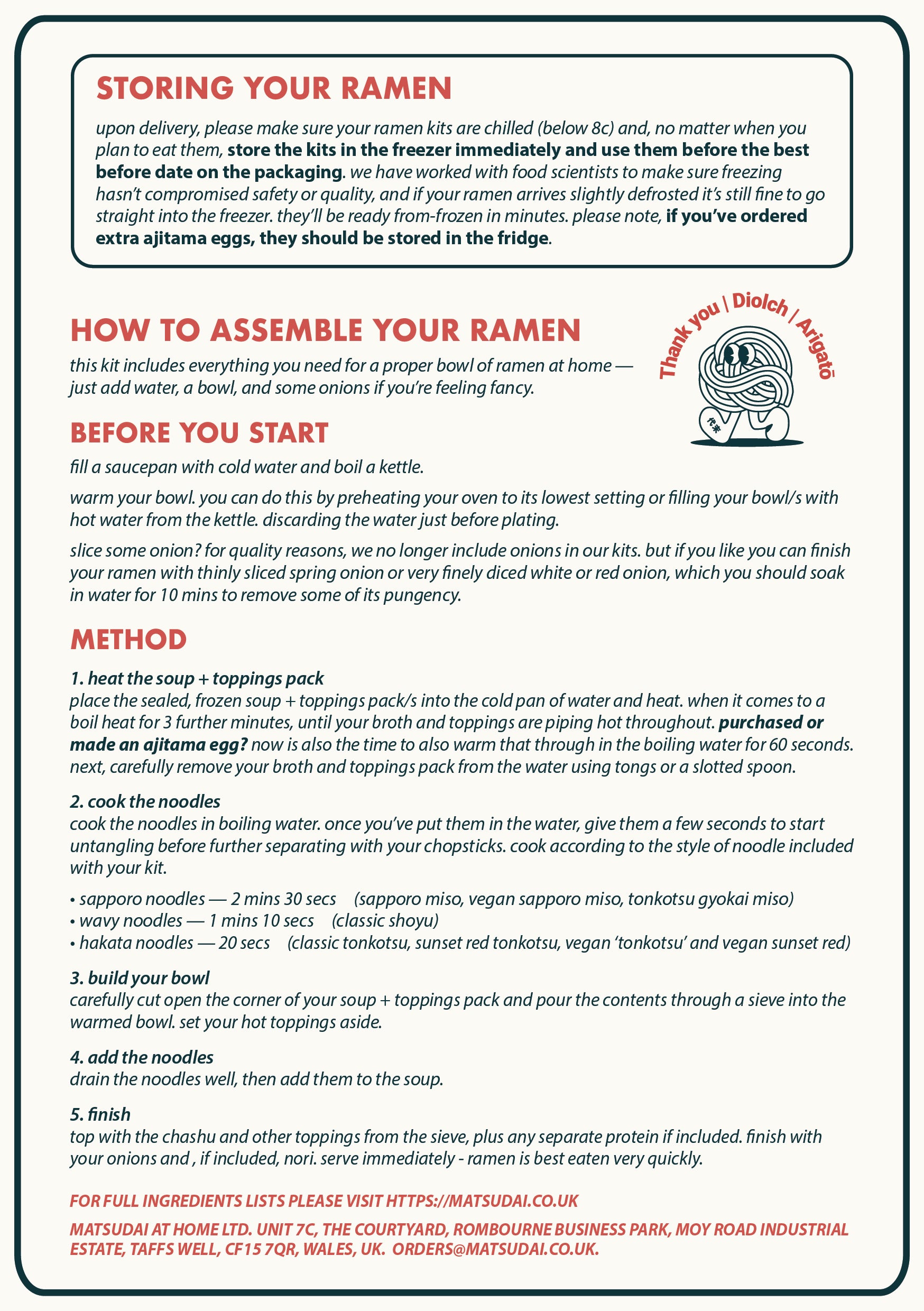
always store our ramen kits in the freezer. ajitama eggs should always be stored in the fridge.
ALLERGENS AND INGREDIENTS
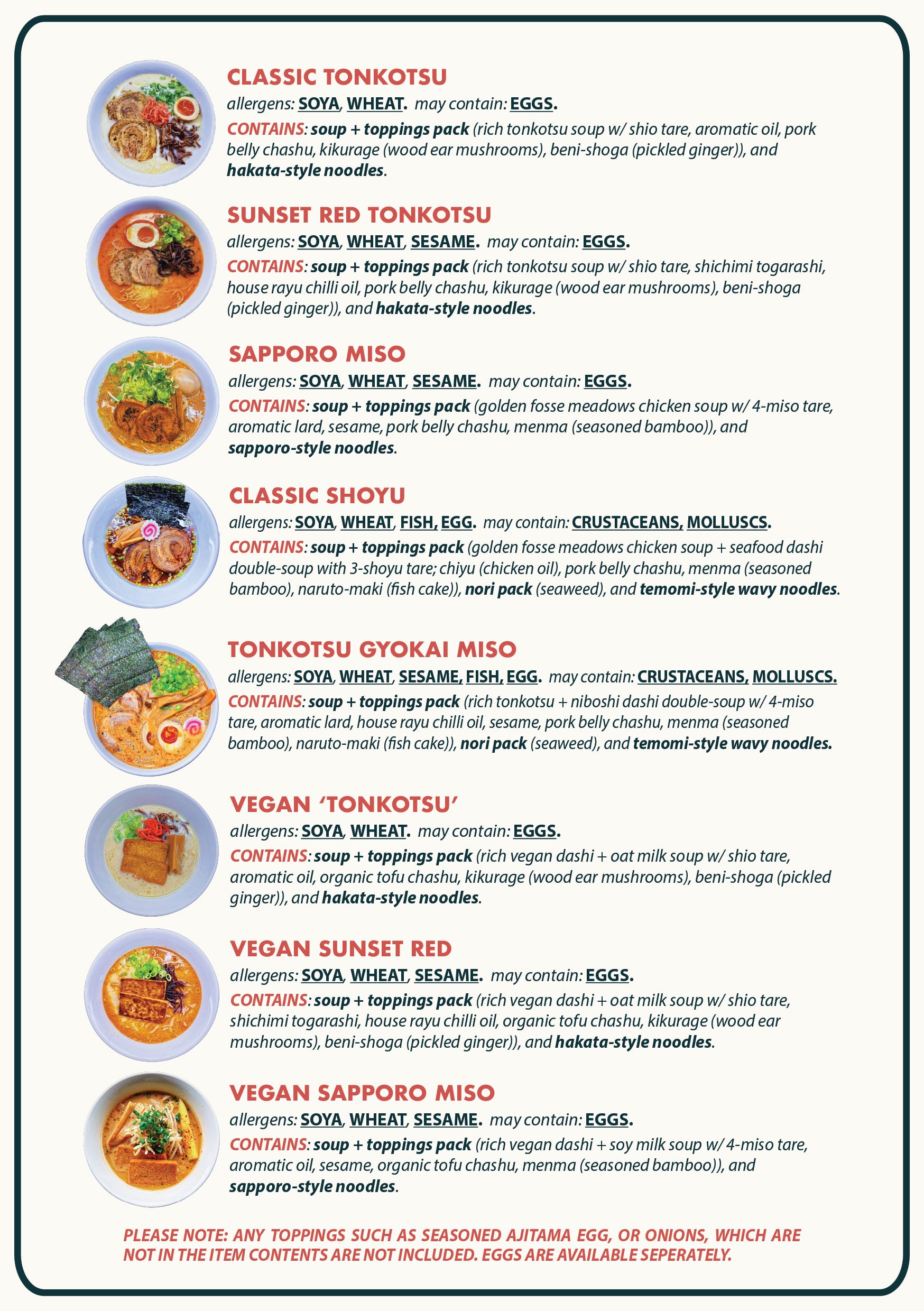
full ingredients and allergens for every kit are listed on that kit's own product page over in the shop.
cooking for someone with an allergy and not certain? email athome@matsudai.co.uk and we'll give you a proper answer.
Which kit have you got?
-
RAMEN
classic tonkotsu, sunset red tonkotsu, tonkotsu gyokai miso, classic shoyu, sapporo miso, tori paitan, triple-yuzu shio, vegan 'tonkotsu', vegan sunset red, vegan sapporo miso, vegan tantanmen -
TSUKEMEN
tonkotsu gyokai tsukemen, tori gyokai tsukemen, spicy sesame tonkotsu tsukemen -
MAZESOBA
tantan mazemen, yokohama mazemen, chippy lane mazesoba
Ramen
Before you start
- grab a frying pan. fill a saucepan with water.a medium or large pan of water will hold its heat better as you make your ramen.
- warm your ramen bowl.pop it in the oven on the lowest setting or warm it with hot water from the kettle.
- grab some onion, if you fancy.fresh onion is a great addition to our ramen: finely dice white or red onion and soak in water whilst you prep or thinly slice spring onion which you needn't soak.
Method
-
place your saucepan of water on the heat to boil.
-
toppings (including menma, kikurage, beni shōga and more) - carefully cut your topping pack away from your chashu, keeping both packs sealed. place all your sealed toppings in a bowl in the sink. Run the cold tap over them for two minutes then set aside, leaving your toppings to stand in this water while you make your ramen.
-
broth - carefully place your sealed, frozen broth pack into your pan of boiling water. bring the water back to the boil. you'll boil for at least 10 minutes in total (ramen styles can vary) until your broth is piping hot throughout.
-
chashu (your protein pack. pork belly, tofu, soboro, shredded chicken thighs and more) - once your broth is entirely defrosted (usually at minute 3 or 4) gently agitate it with a slotted spoon to circulate the broth in the pack. add your sealed chashu pack to the boiling water and continue to boil. put your frying pan over a medium heat.
once your chashu has been submerged in boiling water for two minutes, carefully remove it with a slotted spoon. when the packaging is cool enough to touch, cut open your chashu pack and discard the packaging. add your chashu to the hot frying pan to finish thoroughly reheating and add colour.
your broth should now be piping hot. very carefully remove your broth pack from the water using a slotted spoon and set aside in your warm ramen bowl.
-
ajitama egg- if you're enjoying an ajitama egg with your ramen, remove your egg from its packaging and place it in a bowl in the sink. you're going to pour hot noodle water over your egg when you drain your noodles.
-
noodles- remove your noodles from their packaging and drop them into the boiling water. give them a few seconds to start to come apart before further separating by gently swishing with your chopsticks as they cook. cook according to the style of noodle included with your kit:
- sapporo noodles2 mins 30 secs
- hakata noodles20 secs
- wavy noodles1 min
- tsukemen noodles4 mins
drain your noodles well, covering your egg with the hot water, and leave to warm while you build your bowl.
-
build your bowl - being very careful to avoid steam, cut open the two top corners of your broth pack and pour the broth from one of those corners into your ramen bowl. add your noodles, swishing to separate in the broth. arrange your chashu and toppings with care. finish with onions, to taste. add nori, if included.
tag us @matsudairamen if you snap a pic before you dive in, and enjoy!
ajihen, meaning flavour change, is the Japanese idea of customising your bowl midway through the meal, with your favourite condiments. our award-winning rayu chilli oil is perfect. find this, and more, in our pantry shop.
Tsukemen
tsukemen is dipping ramen. your broth stays in its own bowl and you dip the noodles in a few at a time. cold noodles against hot broth is the whole point of it.
Before you start
- grab a frying pan. fill a saucepan with water.a medium or large pan of water will hold its heat better as you make your ramen.
- warm one bowl, leave one cold.your broth goes in a warm bowl, your noodles in a cold one. pop the broth bowl in the oven on the lowest setting or warm it with hot water from the kettle.
- keep the cold tap free.your noodles get rinsed at the end and it matters more here than it does in a bowl of ramen.
- grab some onion, if you fancy.fresh onion is a great addition to our ramen: finely dice white or red onion and soak in water whilst you prep or thinly slice spring onion which you needn't soak.
Method
-
place your saucepan of water on the heat to boil.
-
toppings (including menma, kikurage, beni shōga and more) - carefully cut your topping pack away from your chashu, keeping both packs sealed. place all your sealed toppings in a bowl in the sink. Run the cold tap over them for two minutes then set aside, leaving your toppings to stand in this water while you make your ramen.
-
broth - carefully place your sealed, frozen broth pack into your pan of boiling water. bring the water back to the boil. you'll boil for at least 10 minutes in total until your broth is piping hot throughout. tsukemen broth is thicker than a ramen broth, so it wants a gentle agitate once it's loose.
-
chashu (your protein pack. pork belly, tofu, soboro, shredded chicken thighs and more) - once your broth is entirely defrosted (usually at minute 3 or 4) gently agitate it with a slotted spoon to circulate the broth in the pack. add your sealed chashu pack to the boiling water and continue to boil. put your frying pan over a medium heat.
once your chashu has been submerged in boiling water for two minutes, carefully remove it with a slotted spoon. when the packaging is cool enough to touch, cut open your chashu pack and discard the packaging. add your chashu to the hot frying pan to finish thoroughly reheating and add colour.
your broth should now be piping hot. very carefully remove your broth pack from the water using a slotted spoon and set aside in your warm broth bowl.
-
ajitama egg- if you're enjoying an ajitama egg with your ramen, remove your egg from its packaging and place it in a bowl in the sink. you're going to pour hot noodle water over your egg when you drain your noodles.
-
noodles- remove your noodles from their packaging and drop them into the boiling water. give them a few seconds to start to come apart before further separating by gently swishing with your chopsticks as they cook. cook according to the style of noodle included with your kit:
- tsukemen noodles4 mins
drain your noodles well, covering your egg with the hot water, and leave to warm while you finish up.
-
rinse your noodles - this is the step that makes a tsukemen. run your drained noodles under the cold tap, working them gently with your hands until they're properly cold and no longer slippery. you're washing off the surface starch and tightening the noodles up. drain hard and shake the water out - wet noodles will water down your broth.
-
build your bowls - being very careful to avoid steam, cut open the two top corners of your broth pack and pour the broth from one of those corners into your warm bowl. it goes in as it comes, no water needed. your noodles go in the cold bowl, with your chashu and toppings arranged on top of them rather than in the broth. finish with onions, to taste. add nori, if included.
-
dip and eat - take a few noodles at a time, dip them in the broth and eat them straight away. don't tip the lot in.
tag us @matsudairamen if you snap a pic before you dive in, and enjoy!
soup wari, meaning soup dilution, is how you finish a tsukemen. once your noodles are gone you're left with a bowl of very good broth - loosen it with hot water from the kettle and drink it. a splash of stock or dashi is even better if you have some in.
Mazesoba
mazesoba is ramen without the soup. a thick tare sits in the bottom of your bowl and you mix it through the noodles. mix it harder than feels sensible.
Before you start
- grab a frying pan. fill a saucepan with water.a medium or large pan of water will hold its heat better as you make your ramen.
- warm your ramen bowl.pop it in the oven on the lowest setting or warm it with hot water from the kettle.
- grab some onion, if you fancy.fresh onion is a great addition to our ramen: finely dice white or red onion and soak in water whilst you prep or thinly slice spring onion which you needn't soak.
Method
-
place your saucepan of water on the heat to boil.
-
toppings (including menma, kikurage, beni shōga and more) - carefully cut your topping pack away from your chashu, keeping both packs sealed. place all your sealed toppings in a bowl in the sink. Run the cold tap over them for two minutes then set aside, leaving your toppings to stand in this water while you make your ramen.
-
tare - carefully place your sealed, frozen tare pack into your pan of boiling water to loosen. give it 5 minutes, or until the sauce is piping hot.
-
chashu (your protein pack. pork belly, tofu, soboro, shredded chicken thighs and more) - add your sealed chashu pack to the boiling water and continue to boil. put your frying pan over a medium heat.
once your chashu has been submerged in boiling water for two minutes, carefully remove it with a slotted spoon. when the packaging is cool enough to touch, cut open your chashu pack and discard the packaging. add your chashu to the hot frying pan to finish thoroughly reheating and add colour.
remove your tare pack from the water using a slotted spoon. cut the corner off and empty all of it into the bottom of your warm ramen bowl - scrape it out, you don't want any left in the packet.
-
ajitama egg- if you're enjoying an ajitama egg with your ramen, remove your egg from its packaging and place it in a bowl in the sink. you're going to pour hot noodle water over your egg when you drain your noodles.
-
noodles- remove your noodles from their packaging and drop them into the boiling water. give them a few seconds to start to come apart before further separating by gently swishing with your chopsticks as they cook. cook according to the style of noodle included with your kit:
- wavy noodles1 min
drain your noodles well, covering your egg with the hot water, and leave to warm while you build your bowl. don't rinse them.
-
build your bowl - add your drained noodles straight on top of the tare and toss hard with your chopsticks until every noodle is coated. this takes longer than you'd think. arrange your chashu and toppings with care. finish with onions, to taste. add nori, if included, then give the whole lot one more mix before your first bite.
tag us @matsudairamen if you snap a pic before you dive in, and enjoy!
oimeshi, meaning chaser rice, is how you finish a mazesoba. there'll be tare left in the bottom of the bowl - stir a small scoop of hot rice through it and eat that too.
Got an older kit, with the toppings sealed inside the soup pack?
we split the toppings into their own pack earlier this year. if yours came sealed together with the soup, follow these instead.
matsudai at home ltd, unit 7c, the courtyard, rombourne business park, moy road industrial estate, taffs well, cf15 7qr, wales, uk. athome@matsudai.co.uk